

I visited the Vyne Park housing estate in Basingstoke the other day and I’ll say one thing for Croudace Homes the developer: they certainly have a sense of humour.
To set the scene, at the end of a roadway called Parlour Drive I came across an array of environmental display boards and a piece of engineering that I mistakenly took to be a modern art installation. Only after reading one of the noticeboards did I realise it had something to do with conservation.
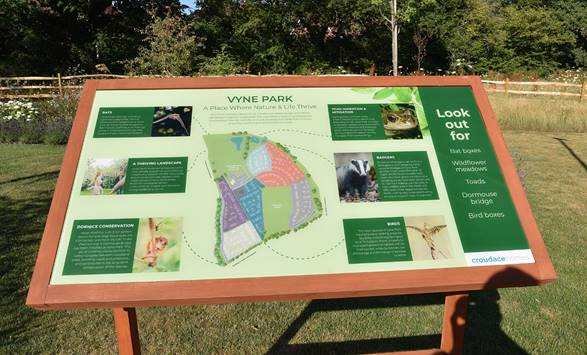
Above: A Croudace Homes’ Vyne Park environmental noticeboard. Photo ©Paul Sterry.
How fortunate that Croudace Homes were able to display their green credentials immediately opposite the marketing and sales suite for new homes in the next stage in their expanding development – land that in a former life was Upper Cufaude Farm. We wouldn’t want any prospective house-buyers getting cold feet at the thought of the environmental destruction caused by building their new homes, would we? Nothing should prevent them from realising their dreams of escaping to what was the country.
Returning to the noticeboards and installation, let’s examine some of the claims made by Croudace Homes.
HAZEL DORMOUSE
There is a well-established tradition among developers to name roads after the habitats and species they have destroyed. In the past that might have meant Orchard Road, Meadow View and Hedge End. As a sign of the environmentally-aware times we live in, in modern Basingstoke instead of Asphalt Avenue, Tarmac Road, Concrete Close and Desolation Drive we now have the likes of Floral View, Orchid Road, Skylark Crescent, Lapwing Way and Squirrel Drive.
In the context of my recent outing, I found a prime example of developer irony at the current northern limit of Vyne Park. In order to create Parlour Drive and its flanking pavements, a gap of 20 metres now exists in an ancient woodland tree belt that historically was continuous. Compare the Google Maps Pro archive for 2008 with the present day to see what I mean. Before its removal, this ‘missing’ woodland would have been habitat for Hazel Dormouse and provided connectivity for the species in the wider landscape. The extension to Parlour Drive that cuts through the ancient woodland has been named DORMOUSE AVENUE.
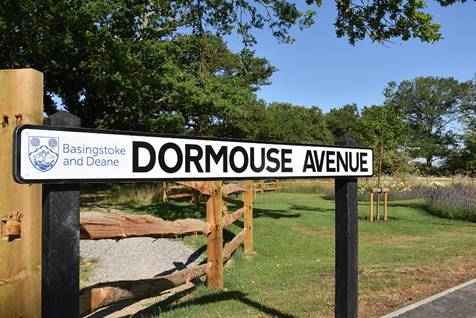
Above: Vyne Park’s delightfully named Dormouse Avenue. Photo ©Paul Sterry.
At this point it might help to understand a bit about the natural history of Hazel Dormice. They are tree-dwelling small mammals that rely on continuous tree canopy cover for connectivity in their search for food and places to nest. Only in a dire emergency will they ever cross open ground. Carve large chunks out woodland, tree belts and hedgerows and you destroy connectivity, creating isolated populations that are vulnerable to local extinction; sheer loss of habitat is also a contributory factor in their decline.

Above: Dormice are strictly arboreal during the summer months but hibernate in winter at or just below ground level on the woodland or hedgerow floor. This makes them supremely vulnerable to terrestrial mammalian predators, especially ones with a keen sense of smell. Photos ©Paul Sterry.
The ancient woodland tree belt that once spanned what is now Dormouse Avenue is gone forever. However, regarding connectivity, to comply with regulations regarding Hazel Dormice (in theory but seldom in practice a protected species) the loss of connectivity has been addressed, in planning terms at least, by the installation of this metal bridge.
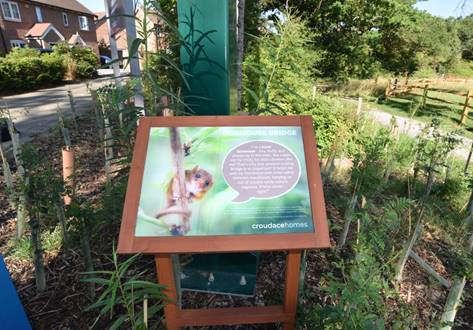
Above: Croudace Homes’ Dormouse noticeboard. Photo ©Paul Sterry.
Common sense would tell most people that for a bridge such as this one to work it needs to connect intimately to tree foliage at either end. And according to the best practice guidance published by Animex Wildlife Bridge when it comes to the key feature of connectivity the advice is to ‘Aim to position both ends of the bridge in optimal habitat’. Even to untrained eyes like mine, I would suggest accessing the tunnel entrance at the moment, across an open-air chasm of several metres, would require a death-defying Olympian feat of athletic prowess and accuracy on the part of any dormouse.
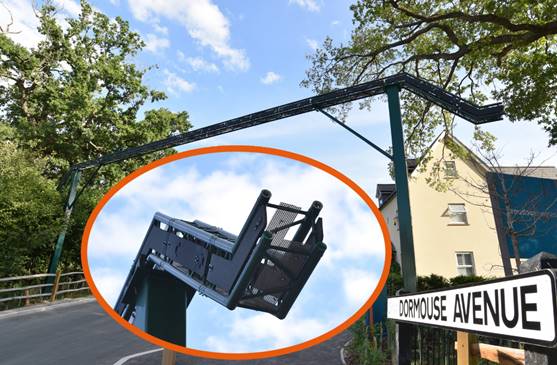
Above: As it stands, ‘Abandon hope all ye who cross here’ is the inscription I would hang from beneath the bridge. Photo ©Paul Sterry.
Clearly Croudace Homes should have completed the installation so the ends of the bridge connected to what remains of the ancient tree line/belt, not thin air. And I assume that like the Upper Cufaude Farm element of the Vyne Park housing estate, the bridge is still in the construction phase and will be completed at some point. But this raises the question of just how long connectivity between the two previously contiguous sections of ancient woodland tree belt has been absent? Google Maps Pro indicates that the tree line/belt was intact in 2022 but that a road-width’s section had been removed by 2024, without any dormouse bridge being put in place.
Infant trees have been planted beneath the bridge ends, and might conceivably help with connectivity in a decade or so. But only if dormice survive that long, something that I doubt will happen. Short of installing New Zealand-style predator fencing surrounding all potential dormouse habitat on the housing estate, the army of cats and dogs that will inevitably take up residence will make short work of the local small mammals, not to mention any ground-nesting birds that attempt to breed.
On another note, if Croudace Homes are so keen to help dormice through the installation of bridges in locations where connectivity in the landscape has been destroyed because of development, why stop at one? Why not replace connectivity removed elsewhere on Vyne Park with additional bridges? For example, where Parlour Drive cuts through woodland as it leaves Crockford Lane and where Doric Avenue leaves Parlour Drive. Again, compare the Google Maps Pro archive for 2008 with the present day to see what I mean.
TOADS
As a volunteer Toad Patroller on Cufaude Lane with some ten years’ experience under my belt, I read with interest the section about Common Toads, which states that Vyne Park provides important habitat to support them including wetlands and sheltered areas. That came as something of a surprise since the experience of volunteers is that prior to development the entire site (soon to disappear under bricks, concrete and tarmac) provided terrestrial habitat and a migration route for Common Toads and other amphibians. And as has been pointed out to Croudace Homes, the location of the ponds (in reality SuDS ponds that might take on a role for wildlife by accident rather than design) is so close to the busy highway of Cufaude Lane that if they do become breeding grounds for amphibians that will only make a bad situation worse, in terms of carnage on the road at migration times.

Above: Migrating Common Toads on Cufaude Lane, squashed by a speeding car. Photo ©Paul Sterry.
For any ponds on site to become havens for wildlife and breeding amphibians in particular, human and canine incursions would also need to be prevented. Otherwise, the physical disturbance caused by dogs and poisoning of the water with canine anti-tick chemicals such as fipronil will render them worthless.
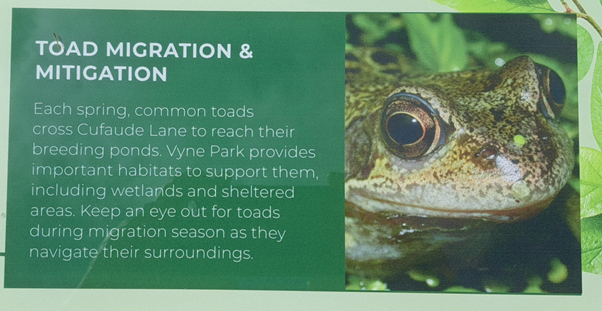
Above: By the way Croudace Homes, it would help if you and your ecological advisors could actually recognise and identify the amphibians you claim to be helping. The image on the board used to accompany your message about Common Toads is actually a Common Frog. Photo ©Paul Sterry.
BAT BOXES
Visitors to the site are invited to look out for bat-friendly planting and roosting boxes in trees and buildings. I am really not sure what constitutes ‘bat-friendly planting’ but I couldn’t spot any bat boxes adorning houses lining Parlour Drive, although perhaps that was my failing eyesight. It came as no surprise that bat-unfriendly loss of feeding and roosting habitat caused by the development did not get a mention. While on the subject of wildlife installations, or the lack of them, I failed to spot any Swift boxes or bricks, even on the byway leading off Dormouse Avenue called, ironically, SWIFT LANE. I took that to be more evidence of Croudace Homes’ sense of humour.
BIRDS
Continuing on the subject of birds, the noticeboard singles out Skylarks and states ‘The open spaces of Vyne Park have provided nesting areas for Skylarks, a declining farmland bird’. There is an element of truth in that, the emphasis being on use of the past tense. Prior to building on the Upper Cufaude Farm element of Vyne Park, Skylarks certainly nested on the site’s farmland. Building on the the land will contribute to their decline in the local area and, being ground-nesting birds of open countryside not housing estates, I doubt any Skylarks will survive once the development is complete.
CONCLUSION
All this would be laughable if it were not so tragic and the sad thing is that most people glancing at the display boards will choose to believe what they read. And I can picture local councillors patting themselves on the back for the positive outcome for the natural world they have helped achieve.
In one way or another, all developments destroy wildlife and the natural world. An acceptance of that fact is essential if we are to minimise if not avoid the impacts and create meaningful solutions to enhance what remains of our dwindling biodiversity.
None of this will matter, of course, if the Planning and Infrastructure Bill gains Royal assent in its current form. For large developments such as Vyne Park, it will be business as usual but small and medium-sized developments will not even have to pay cash to trash the environment – they will be able to do it unhindered.
Returning to the subject of road names, when the next phase of the Vyne Park housing estate is completed, Parlour Drive will no longer be a quiet dead-end, but will become a major thoroughfare. In addition to residents of Vyne Park, you can add to the mix vehicles heading for and leaving the site of a proposed Taylor Wimpey housing estate immediately to the west of Vyne Park. At that point residents might want to consider renaming Dormouse Drive. To maintain the rodent theme, how about BROWN RAT RUN as a contender?
 nplsecondnature.com
Yesterday (24 Sep 25), I was assisted by 13 of the strategic land and planning managers of Taylor Wimpey (South East, Central & West England) together with the area diector for same to plant oak trees in our woodland. See :- https://oxfordshirewoodlandgroup.co.uk/forum/?mingleforumaction=viewtopic&t=570.0#postid-1059
These were all thoroughly decent people who worked hard to achieve our collective goal to improve the environment. I don’t think that there is anything malicious about strategies adopted by them or other developers or planning authorities but instead possibly a simple lack of understanding about the consequencies of their actions.
Days like yesterday have provide us with the opportunity to hopefully educate those engaged in this field and help make them more aware of the likely outcomes of strategies and actions proposed to be pursued.
For example we introduced the T-W managers to the invasive edible dormouse (glis glis) which has now reached West of Reading & S. Oxon and their like for eating through domestic electric cables and plastic water pipes that are now much favoured by house builders.
There is clearly a balancing act between house development and nature consrvation in which we all have a part to play and not simply provide lip service to likely outcomes.
LikeLike