
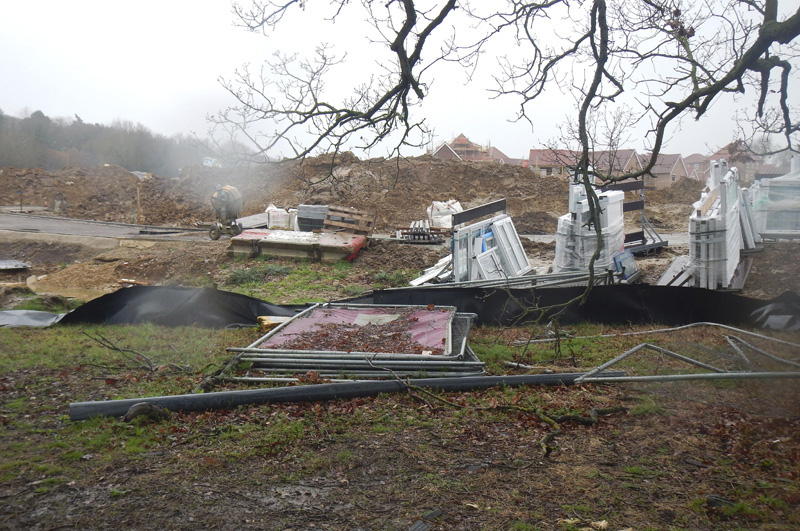
If awards existed for local councils with woeful environmental track records, I would be nominating Basingstoke & Deane. However, since no such ‘BRITAIN LACKS VISION’ honours exist I, and other similarly like-minded citizens, will have to make do with offering constructive criticism of council policy. There’s a prime opportunity to have our say right now.
Basingstoke & Deane Borough Council are currently going through the process of creating a new Local Plan and are seeking consultation. If you are getting a sense of déjà vu, you might well ask what happened to their last attempt to make a Local Plan? That’s another story, one that featured in a NPL Second Nature blog in 2024.
Going back to basics, a Local Plan is a set of policies and land allocations prepared by a local planning authority to guide future development in its area, and covers subjects like housing, employment, and infrastructure, all the while supposedly balancing development with environmental protection. It is not an abstract piece of legislation but something that has a direct impact on the lives of existing residents in an area, and the environment in which they live. A Local Plan should be fit for ecological purpose, as well as demonstrating social vision. A good Local Plan embodies policies that are approved of by its residents, not imposed on them.
Judging by Basingstoke & Deane’s Draft Local Plan, the council’s vision for the future of our town and countryside seems to largely marginalise the natural world, erode protection for biodiversity and important habitats, and ignore the need for landscape-scale ecological connectivity. It is up to residents with environmental awareness to have their say and emphasise their priorities. And remind the council, and council officers employed on the taxpayers dime, of their statutory responsibilities. For me and many others, what remains of the natural world in Basingstoke is the only thing that makes living in the borough in the least bit worthwhile. It is still worth fighting for.
To some degree the council’s hands are tied by changing national policy and the backdrop of the current Government systematically dismantling and emasculating environmental legislation that previously protected our threatened and dwindling biodiversity. But that doesn’t mean they should roll over and accept every diktat. Nor should they be swayed by the sneering anti-nature rhetoric that continues to spew from the mouths of many politicians, who blindly advocate economic growth at any environmental cost and continue to perpetuate the lie that nature is a hindrance to advancement.
Commenting on Local Plans is a daunting prospect. Fortunately, that excellent organisation Natural Basingstoke has done much of the hard work. They have already provided detailed comments and feedback to the council, plus a template letter that individuals can use or adapt, then submit to the council. It can be found on the Local Plan page of Natural Basingstoke’s website; alternatively, you can follow this QR code:

If you, and for that matter Basingstoke & Deane council officers, want to see what ‘good’ looks like in terms of local authorities and their approaches to environmental protection, support for the Nature Recovery Network, and engagement with biodiversity enhancement, have a look at the following from elsewhere in England:
Wilder Wealden – a partnership between the Wealdon District Council and Sussex Wildlife Trust
Wilder Horsham District – a partnership between Horsham District Council and Sussex Wildlife Trust
Wilder Ouse / Wilder Wealden – a partnership between Wealden District Council and Sussex Wildlife Trust.
Weald to Waves | Connecting nature across Sussex – creating a 100-mile nature corridor across Sussex, connecting fragmented landscapes to boost biodiversity, capture carbon, enhance food production, and enrich the rural economy.
Maidstone Borough Council’s Nature Recovery Fund | MBC Climate Change and Biodiversity
North Devon’s Nature Recovery Plan
Walsall’s Wild Walsall – masterminded by the Birmingham & Black Country Wildlife Trust.

